Showing posts with label The Netherlands. Show all posts

Thursday, December 6, 2012

Sinterklaas 2012

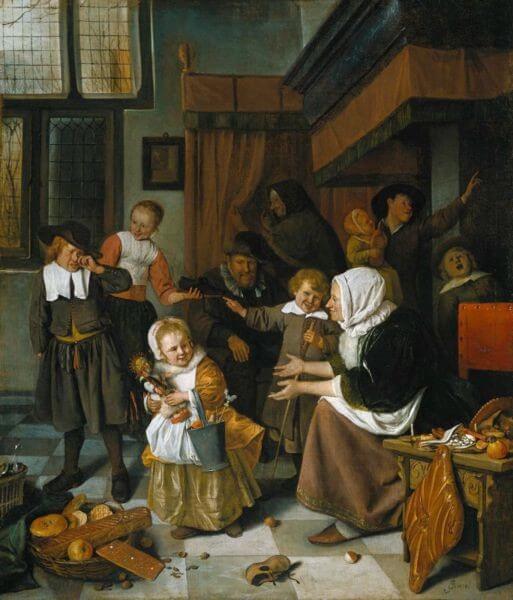
Het Sint Nicolasfeest, Jan Steen.  Image via Kunst en Cultuur
I was almost certain that I had written something about Sinterklaas before (Feast of St. Nicholas), but glancing through my archives I noticed that there wasn't a post dedicated to it, and I don't have a label for it.  How could I have gone so long and remained silent on the subject?  The Dutch celebrate Sinterklaas on December 5 (Feast of St. Nicholas Eve).  Sinterklaas comes on his white horse with his helper, Zwarte Piet, to deliver gifts to the deserving children of the Low Countries.  Yes, I have a problem with the blatant, racist overtones of the black helper to the white saint, although very few people here seem to be troubled by it.  If you want to know more about that from an expat's perspective, you can read the Jessica Olien's Slate article from last December.

As a fairly integrated foreigner, I try to roll with the differences in culture without succumbing to or becoming an apologist for the aspects I find less than acceptable.  I like to think I do the same with American culture, too, although it is tougher when you're on the inside trying to observe your own sense of identity with a critical eye.  I told Niek that we could celebrate Sinterklaas with Johanna if he wanted to, but that I would draw the line at letting her wear a Zwarte Piet costume or ever, ever, ever wearing blackface.  Seriously, that is just not going to happen.  I'll happily explain to her when she's old enough to understand why it isn't acceptable.

I think we would have let Sinterklaas pass this year without any sort of celebration if we hadn't been invited to a party at our friends' house.  It was a pretty serious affair replete with a visit from Sinterklaas and Zwarte Piet themselves.  My friend's brother-in-law filled the role of Sinterklaas and her brother happily dressed up to play the part of Zwarte Piet.


Never have I seen children so excited and terrified all at once.  I suppose it's the same mixed bag of reactions you would see at a mall while kids wait to sit on Santa's lap.  Just like Santa, he knows whether you've been good or bad, and also just like Santa, he brings you gifts.  Instead of elves to do his bidding and manual labor, though, he's got an army of Zwarte Piets to carry his bags, pass out the gifts, and throw (literally throw, as in chucking with full force) handfuls of little cookies and candies to the waiting throngs of children.  The last part is what Johanna liked best as she scrambled around the living room picking up the cookies and popping them in her mouth before I could stop her.  Sitting on a  stranger's lap...yeah, she did not allow that to happen.

Here's a pic of Piet getting ready to throw the pepernoten (the hard, spice cookies) to the crowd.

I really am not sure what Johanna thought of the whole operation.  This was taken a few moments before her name got called.  When Niek brought her closer, she just started wailing.  Right there with you, kid.  I didn't want to sit on the Sint's lap either, even though I had to.


Here's Niek showing me how it's done.  Good times.  All the adults got the traditional chocolate letters. My "D" was pretty delicious.


Honestly, this is my favorite pictures from the entire day.  Sinterklaas, at its heart, is a child-centered holiday, and every parent wants to capture the memories of childhood.  With the explosion in popularity of the smartphone has come the instantaneous record keeping of daily life done en masse.


That was our first Sinterklaas celebration as a family.  I still don't know how to broach the subject of Zwarte Piet with the Dutch.  For the most part I just look at all the Piet decorations and the Piet costumes with a mixture of awe and irritation.  However, I love seeing how excited all the kids get about Sinterklass visiting and their anticipation for the likely gifts they'll receive. The kids were so cute and really bought into the theatrical display of their beloved Sint.  I'll have to see how Johanna reacts next year when a towering man in a miter tries to lure her onto his lap with candy and presents.

Tuesday, June 21, 2011

Hollandse Nieuwe


It’s the middle of June, and that can only mean one thing (actually that could mean anything, but for a blog about food in the Netherlands, it means something pretty special)…it’s time for Hollandse Nieuwe.  Mmm, Hollandse Nieuwe.

This delicacy of the Atlantic is known as herring to the uninitiated, and more specifically, Hollandse Nieuwe refers to the first catch of the season. The resemblance to the herring of my childhood is negligible, not that I have a really clear picture of it in my mind anymore.  I just remember an unsightly gray mass always present at family gatherings next to the pickles and olives, a pile of pickled fish from a jar I consciously avoided on my way to the chips and seven-layer taco dip. Dutch herring goes through some sort of salt curing process and arrives to the consumer nicely filleted and in a fairly fresh state.  The season only lasts about six weeks, but they freeze a lot of the stock to sell throughout the rest of the year.  I missed the season last year, because I was back in the States for eight weeks.  No way was I going to miss it again this summer.  While most people in the line ordered it as a snack, complete with the requisite chopped onions, I got mine nicely packaged up for dinner that night.  Look at this adorable bag:
If you take a look at the first picture from this newspaper article, you can see the “traditional” way Dutch people eat herring—all in one go—but I have never seen it served that way here in Amsterdam.  The fishmonger usually cuts it up nicely for you so you can enjoy each little piece while sitting on a bench watching the bicycles go by.  That’s what the tourists usually do, anyway.  While some people may not think that pieces of herring with onions sounds good, it is actually pretty amazing.  The bite of the onions offers a nice contrast to the fatty fish.  Man, just writing this is making me want to go order one.  
Apparently it is a good year for the little fish.  The ones I bought were huge!  I bought two of the little suckers for dinner, but we ended up only eating one and saving the other one for our appetizer (yeah, like we usually have appetizers before dinner) the next night.  It’s one of those fresh foods I wish I could somehow bottle up and send to people so they could know just how good it is.  Since that’s not possible, you should all come visit me in the next few weeks before the season ends.

Monday, September 6, 2010

Crossing over to the carb side

I just want to post a little note about a particular eating habit I picked up rather seamlessly last week.  The first time I was in the center of the city running some errands, and I was starving.  I could have bought a candy bar or a little bag of chips, but instead I made a beeline for the nearest bakery and bought a croissant for €0,70.  The second time was on Saturday morning while Niek and I were doing our grocery shopping.  We had just finished going for a run, and there wasn't much in the way of food in the house, hence the grocery shopping trip.  Right after we purchased our three loaves of bread from the baker (that's not a typo, the two people in house consume three whole loaves of bread per week) which also consisted of an embarrassing incident involving the woman behind me in line making a comment about me kissing the loaf of still warm bread in my hand and my stuttering reply that I was merely smelling the bread and not kissing it in some sort of strange ritual which is what she had assumed, I practically ripped open the bag to eat a piece of bread for breakfast.  Apparently I've passed over into the Dutch universe where it is the norm to always stave off hunger by eating bread and just bread.  If you couple this eating habit with my newly found ability to ride a bike in the rain while I hold an open umbrella, you almost can't tell the difference between me and the Nederlanders around me.  If only I could grow about eight more inches...then you really might start to think I was Dutch.

That is all.  Back to yet another overdue chapter, a looming deadline, and a conference panel application, etc., etc.

I think I write a lot about bread on this blog.

Wednesday, August 25, 2010

Cooking and Gender

Last week I had an experience that almost turned me into a vegetarian: I bought chicken from a butcher specializing in sustainable/organic meats...and it was the most expensive chicken I have ever purchased.  While the nice lady behind the counter told me the price and started packaging the bird in fancy paper touting all sorts of organic stamps and labels, I just stood there in a weird shocked silence, unable to take it all in, and then with my body on auto-pilot I paid.  The whole way home I just kept telling myself that it wasn't possible I just paid that much for a chicken and if this was the cost of buying "responsible" meat, we were going to have to 1) find second jobs, 2) stop caring about how livestock is treated, or 3) give up meat. None of those really feel like good options to me, and I haven't yet worked out what we're going to do about it, but in the meantime we won't be roasting any more chickens.

I found myself at the butcher in the first place, because we were having friends over for dinner (diehard meat eaters who wouldn't touch a vegetable with a ten-foot pole, or fish or cheese), and Niek wanted to work on his chicken roasting skills.  In the last few years, he's become something of a chicken roasting afficianado, and he'll most likely be working on perfecting his technique for the next few decades.

And this brings me to the actual point of the post, which is supposed to be about the gendering of cooking and my experiences in the Netherlands.  Growing up in the Heartland, I didn't see a lot of men using their skills in the kitchen.  I don't think I can say that any of my childhood friends' fathers cooked, and I don't remember my dad ever making us dinner (now that my dad is retired, he's taken on a lot more of the dinner making duties, so kudos to you, Dad).  Grilling on the barbeque doesn't count, since I would say it's seen as a pretty masculine activity.  There are plenty of discussions in our modern world about how home cooking is still perceived as women's work, and I really wanted to site this article, but my proxy server to the university's research library wasn't granting me access, although I found an amusing anecdote about gender and cooking here and a rather angry assessment of Michael Pollan's take on the matter here.  Interestingly enough, all of the partners of my friends know their way around a kitchen, and some of them even do the majority of the cooking in the relationship.  Regan should tell you about her husband's forays into bread, cheese, and beer making.  I'll refrain from using my guy friends as a representative slice of American culture since I dabble a little more in that crazy intellectual/academic world than most people.  But whoah, am I digressing a little bit?

This is really about gender and cooking in my home away from home.  Most of the home cooking I have experienced in the Netherlands has either been in my own household or in that of my in-laws where my mother-in-law wouldn't dream of preparing a meal and my father-in-law has been in charge of family dinners since my husband can remember.  It was early in our relationship that I learned that Niek's dad was the cook of their house, and I remember being a little shocked hear it.  It shouldn't really have come as a surprise to me considering that Niek cooked dinner for us on our second date and cooks about half of the time now.  Maybe if both of us didn't work it would be different, but since we both find ourselves busy with work and we both actually enjoy cooking, we are able to maintain a fairly even split.  I love that I find myself in a family that supports everyone's interests and skills and doesn't really seem to divide household responsibilities among any sort of gendered guidelines.  Are there swaths of Dutch culture that see women as being responsible for cooking simply because they're women?  Absolutely.  Is it a hard an fast rule everyone ascribes to?  No, and I am quite happy for that. 
Niek's chicken and roast potatoes were a rousing success the other night, even if he didn't think the skin was crispy enough.  Cooks are usually their own worst critics, which I know from personal experience.  It just gives him another reason to try again the next time we have a few friends to dinner, although we may have to wait at least a few weeks.  I'm  going to have to brace myself for the cost of buying another organic bird.

Wednesday, June 9, 2010

Doing Dutch Things and Eating American Stuff

 
In the past week, I've done a bunch of things that have made me feel really Dutch, or at least have given the appearance that I am becoming "integrated" (ugh, I shudder at the use of that word to describe immigrants in The Netherlands, but that's a different post, a really different post). Here are a few of the things I have done after which I realized I would do almost none of those things in L.A.

1) Right before catching the train home from my day at an archive, I popped into the drugstore at the train station and bought candy. I stood there at the buffet of candies just like all the other Dutch professionals looking for a nice sugar fix to get them home.  I even tried again to like black licorice, going so far as to sample one while I was stuffing my pointy bag with gummi bears.  Blech, big mistake.  It was a harder, salty kind that at first lulled me into a false sense of security.  In fact, I almost liked it and thought that would be my turning point moment.  I could write a post about the day I taught myself to like anise.  But then as I was standing in line to pay, still chewing on that piece of candy, because it took like five minutes to chew completely, the flavor went from slightly salty licorice to the taste of ammonia.  It was like I had bleach flavored candy in my mouth.  That was it, I'm done with the black menace for at least another six months.  The other candy was heavenly to eat as I sat in a train and watched the Dutch landscape go by.

2) My bicycle got a flat tire a few weeks ago while I was riding it in the rain (super Dutch thing to do), and I finally got around to fixing it this weekend.  Never in my life have I fixed a flat tire on a bike.  Before coming the Netherlands, I don't think I had been on a bike in years, and I had somehow gotten through my entire childhood without ever getting a flat tire. Niek isn't a fan of fixing his flat tires; he usually takes the bike to the bike shop down the street when there's a problem.  However, I was feeling a bit embarrassed that I didn't know how to solve a seemingly simple problem.  I went to the bike supply store, which is kind of like going to NAPA Auto Parts except this time it's for your bike, and had the nice gentleman behind the counter help me locate a tube repair kit.  It was obvious I had no idea what I was doing, so he told me to bring it in if I couldn't figure it out.  Lucky for me Niek is Dutch, meaning he was born with the knowledge of basic bike repair, even if he doesn't use that knowledge very often.

Seriously, I am beaming at my newly found ability to perform a simple task, and also that I did it in a skirt and a white sweater without getting dirty.  When I told my in-laws that I patched my tire, they told me I am now qualified to be a Dutch citizen.  I somehow don't think tire repair is a portion of the citizenship examination, but it's still a good skill to have.

3) I ate appeltaart...Not really necessary to expand on that since I've made it quite apparent how much I love this food.  Eating it on a terrace on a beautiful summer day is what made it even more of a cultural experience.  I have been waiting patiently through all the cold and rainy months to talk about terrace culture in The Netherlands.  I don't know if terrace culture is really the right word.  The outdoor space a café, bar or restaurant has is always referred to as a terras in Dutch, so I'm just anglicizing the word.  When it is sunny and warm here, which it is maybe 10% of the year, the Dutch flock to outdoor cafés to enjoy the sunshine and a good witbier, or in my case this last time around, a good coffee.  They just sit for hours, talking and watching the world go by.  I love how busy and full outdoor spaces become in the summer, and it is by far my favorite summer activity.  You've got to soak it up and enjoy it while you can, because before you know it, the days will be shorter and it will be too cold and wet to be outside.  Niek was just excited to finally try the cinnamon ice cream.  He was pretty jealous that I had been here with Regan but never with him.  Yes, the ice cream and appeltaart did warrant such an enthusiastic response.  We sat and talked about politics and the economy since those things were on our mind with the big election for parliament coming up, and we basically just enjoyed ourselves.
Those were the three things I've done in the past week to make me feel really Dutch.  When all is said and done though, I can't help but still feel pretty American, especially in the kitchen.  Yesterday when I wanted something sweet, I still pulled out one of my American cookbooks and whipped up a concoction Niek had never heard of before: blondies (kind of like brownies minus the chocolate).  I had never made them before, but a few recipes for them have come up on my favorite baking blogs, so I figured I'd give them a try.  These particular ones called for brown butter, which I had also never made before.  I made sure to get a shot of my excitement after I had successfully created clarified butter, a lot of butter:
Oh they are so good.  Totally worth using up the last of my vanilla extract.  They go really well with Dutch coffee.

Thursday, April 15, 2010

How to tell it's April in Amsterdam

1.  The daffodils are almost finished blooming and the tulips are almost ready.

2.  Amsterdammers are sitting on terraces and drinking witbier.

3.  We slept with the window open last night.

4.  The dog has been led deep into the wilds of the park in search of the sources of the million smells his nose is taking in.

5.  I ran outside in shorts, a t-shirt, no hat, and my ears and hands didn't get the least bit cold.

6.  The sun now sets at 8:30 p.m.

7.  There are lambs interspersed throughout the herds of sheep.

8.  I have this relentless urge to eat salad.

9.  People just keep smiling as the whiz past on their bicycles sans coats, gloves or scarves.

The real reason that I know it is truly April in the Netherlands can be summed up into one foodstuf.  Guess what I had for dinner tonight.

10.  This right here is spring on a plate...
That's right.  I had white asparagus for dinner.  Asparagus season is upon us, my friends.  I think I've almost wrangled Niek into a trip to the fields in the south of Limburg just so I can experience it in all its glory.  I hope to tell you about it once I convince him to go.

Tuesday, April 13, 2010

The Omnivore's Dilemma and The Netherlands

“Eat food. Not too much. Mostly plants.” -Michael Pollan, In Defense of Food (and in other stuff written by the author)

I was making my dinner last night, pasta with tomato sauce and anchovies (nothing but the best for a Monday), and it just suddenly popped into my head that Niek and I eat quite differently than we used to.  That's due to quite a few factors, actually, and is tied up in the practical concerns of keeping our weekly shopping routine within our budgetary constraints, my desire to eat a more well-rounded diet, my unexplained loathing for taking vitamins, all while we continue to truly enjoy what we eat.  I love to eat; I see it not only as a necessity but also a daily pleasure.  I also hate hearing that there are bad foods and good foods.  Food is just food, isn't it?  Shouldn't it exist outside some sort of moral sphere?  Food never makes choices about what it's going to be or how its going to be consumed.  Those are choices for an individual to make.  You can talk about good and bad systems for growing or slaughtering or processing and packaging foodstuffs if you are talking about those things in terms of their impact on the environment or causing suffering. You can talk about good or bad diets, although I also take issue with moralizing a diet.  If you watch The Biggest Loser, which I have been known to do on a weekly basis occasion, you can see how easy it is for the trainers and the show to demonize inanimate objects (food) and watch as the contestants are redeemed from their unhealthy (bad) ways and become reborn as happy, slender, healthy (good) individuals.  The show icks me out a bit, and yet I continue to watch it.  Hmm.

If you think I'm starting to sound like I've read too much Michael Pollan, then you would probably be right.  I've only read his Omnivore's Dilemma and in that book I found an individual grappling with the choices he makes daily about what he is going to eat.  I loved that he wanted to understand the systems at play in the U.S. that bring him so many food choices, and I loved that he wanted to find a balance between feeling good about his food choices without making every trip to the grocery store a moment of crisis in his life.  If you haven't read the book, I would suggest it as a a nice, easy weekend read. I've heard great things about In Defense of Food, too.  His revelations aren't groundbreaking by any means, but he presents them in an easy and entertaining way.

Pollan's book was just the last in a series of progressions in my life that have truly forced me to think about my food.  In my early twenties, I saw Supersize Me just like the rest of my cohort.  I read Fast Food Nation, which to this day has put me off chicken nuggets.  (If you want to know about the lives of packing plant employees you can read Fast Food Nation, or you can also ask my mom about the summer she spent teaching English to Mexican immigrants working at a local meat packing plant in Nebraska.  They did not have easy lives and most definitely did not have easy jobs.)  I have perused countless articles in magazines like The Atlantic, The New Yorker and the Dutch De Groene Amsterdammer.  I'll just mention in passing a pretty disturbing program on PBS about aquaculture that ended my love affair with farm-raised salmon and shrimp.  Reading Pollan's book was no big jump for me, and it reinforced the ideas behind the way I eat more than it changed it.

Do I sound like an overly-sensitive, overly-educated, tree hugging, organic cotton wearing academic/intellectual to you yet?  I think that I do.  For the record, I don't own any organic cotton clothing...yet.  I would say, however, that growing up in the Midwest with parents deeply committed to conservation efforts (shout out to Ducks Unlimited and Quails Forever) and eating well had just as much to do with the way I look at food as the books and articles I've read as an adult.  My dad often went hunting and fishing when I was a kid, and I cannot tell you number of times he reminded me that we should only ever bring home as much as we could eat.  Seriously, I'm pretty sure he said that every single time I sat with him the boat.  My dad deeply dislikes trophy hunting, and I think he gets a little sad when he thinks about it.  Do not ask me how my mom found the time to cook a nice supper every night or how she was able to can like crazy at the end of the summer when all the produce from the garden started coming in.  She doesn't can anymore (although she freezes a lot of summer fruits), but when she gave me her canning equipment a few years ago it was like Christmas in August.  Sometimes I feel like some sort of strange amalgam between Midwestern practicality and liberal higher education with a sprinkling California Cuisine philosophy for good measure.

So what does all of this have to do with food and the way I eat in the Netherlands?  Well, quite a lot.  Los Angeles made it easy to eat and cook the way I wanted to without much effort, much easier than in the Midwest.  Do you realize there is more than one strawberry season in SoCal?  I would notice it every few months when the price of strawberries would drop in the stores.  "Ah, must have been time for another harvest in the Central Valley," I would think.  I could splurge on some locally grown stuff at the farmer's market when I felt like it, buy conventionally grown produce at the Persian Market for the whole week for about $15, and get my hormone free milk and Greek yogurt at Trader Joe's.  It was fabulous, and I loved the routine I had created for myself in L.A.  I hated that I had to drive to get to all of those places, but I loved that I could go months without needing to set foot in a regular grocery store (except for baking necessities like highly refined sugar and cake flour).  Now almost two years after my move to Amsterdam, I am still struggling with my shopping routine.  The struggle is probably why you have to read about it so often on this blog. So, sorry about that.

The older I get and the more I read, the more shopping for food becomes a conscious act of making choices: choices for nutritious food, choices about sustainability, choices in support of humane livestock operations.  Some things are really easy for me; I just don't buy chicken or eggs unless I know the chickens did not live their lives in cages.  (I have been to large-scale chicken operations, and I hate them.  You try not feeling disgust at a factory farm.  Go ahead, just try it.) The gray areas begin and the choices becomes more difficult when I consider grains and produce.  With the newest catch word in "responsible" food choice, "local," swimming around in my brain, I start to wonder about the food in my basket.  Can I buy that kiwi? It had to be flown from New Zealand to get here, so I don't think it's particularly fresh or environmentally friendly, but it would taste so delicious in a fruit salad.  Should I buy this bag of bulgur even though it had to come from Turkey to be here?  What about the figs from Morocco and the blood oranges from Spain? I can't quite give up imported produce and subsist on the fruits and veggies grown locally in the Netherlands in the winter.  That would involve months of nothing but root vegetables and stored apples, and that sounds not at all appealing to me.

The way people eat is also just so different here.  Correction, the way I want to eat and the lengths I need to go to eat that way lead me to conclude that people eat very differently here.  I didn't notice it at first, but it's become more and more apparent to me in the last year.   Perhaps you are thinking to yourself, "Duh, Diana.  It's a foreign country, of course it's different."  Obviously I know it's going to be different, so maybe what I should say is that it seems like food is unvaried.  I can't really say with any authority at all how varied a typical Los Angeleno's diet is, but I do know that the options felt so limitless when I lived there, and I feel kind of fenced in here.

I suppose my efforts for better eating, and to some extent more responsible eating, has focused on cooking as much with whole foods as possible (whole grains, dried beans, good nuts, butter, olive oil, blah, blah, blah), giving myself lots of choices, and not overdoing it on the processed foods.  I love sweets, and I eat something sugary everyday, but I wouldn't define that as overdoing it.  Eating should be enjoyable and I enjoy my sugar.  Creating too many rules and restrictions around food could make anyone, but definitely me, cranky and unhappy.  I "heart" Michael Pollan's book so much, because he wants you to enjoy the food you eat, and part of that process is through variety.  This, unfortunately, is why Amsterdam  can continue to feel like a foreign place to me.  I want variety with my food choices, and I haven't been successful at finding that here.  Maybe I'm not looking hard enough, but I keep finding the same food wherever I go.  I find lots of Gouda cheese (yum), lots of bread, lots of meat, and a few of the same fruits and vegetables.  When I want whole grains or beans, I go to the Moroccan market and shop with the other immigrants.  If I want fish that doesn't show up on a list of unsustainable species, I have to work really hard to do so.  And when I want whole wheat flour, well you already know, I throw a temper tantrum and realize I'm not going to get it. 

So last night as a I finished eating my spaghetti I thought about Michael Pollan and his eating philosophy.  I thought that sometimes it can be really frustrating here to find the ingredients I want in order to enjoy my dinner.  I also thought how much easier it is for him as a resident of Berkeley, CA to eat the way he wants to.  I thought that I might have taken my time in L.A. too much for granted, although I don't regret leaving it.  Living in Amsterdam, in any foreign place, comes with its challenges, and as an ex-pat food is one of my greatest challenges and joys.  I can eat the way I want here, but I have to be willing to work a little harder at it.

Hey, Regan.  I loved your posts about the market.  Looks like you don't have a problem finding lots of locally grown food. :)
Tuesday, March 23, 2010

Babyshower, Part II

About a month ago, I promised to post more pictures of the baby shower I threw for one of my friends.  I then realized that in all of the excitement of the day, I had failed to take any pictures of the shower or the food that I had been so anxious about preparing and presenting.  Luckily the guest of honor had the presence of mind to snap a few pics of the place before the guests arrived.  She's been kind of busy (something about preparing for the imminent birth of her first child) and just got around to sending me the pictures this past weekend.  If I were a pregnant lady quickly approaching my due date, I'm not sure I would ever have remembered to send a scatter-brained friend some pictures of cupcakes, but she is a much more organized person than I am, so you are all very lucky.

Despite my fear of organizing large events for lots of people I do not know, I was so excited to throw this shower.  My friend is so lovely and just deserved an afternoon of people celebrating her.  Baby showers are a completely foreign concept here, and I have spent quite a bit of time over the past few months trying to figure out why these kinds of celebrations aren't commonplace.  I'm talking about parties that are traditionally meant to bring communities of people together with the goal of supporting and aiding individuals in a new phase in their lives.  I'm thinking of bridal showers, baby showers and house warming parties.  (To be fair, I have been to a house warming party here, and some people did bring gifts, but it wasn't expected, and the gifts were all very small things.  Mostly, people just stood around and drank a bunch of beer.)  You can bet there is no such thing as a registry here, either.  A handful of stores have bridal registries, but a baby registry?  Um, no.  That is just not done.

Please excuse the plastic wrap over the sandwiches.  It's the only photo I have of them.

 
Here are the cupcakes.  I can't believe it took me so long to make so few!

I am not trying to say that Americans only care about getting really good gifts from their friends for their babies or that Dutch people aren't interested in celebrating big life events.  Baby showers have always seemed to me like a community building event.  People come together to talk, eat and share advice in addition to the gift-giving part.  It seems like a great way for a personal and small network to provide support to new parents.  Based on all the stuff my friend and her husband have bought over the last few months, I'm going to go ahead and say that having a baby is expensive.  Isn't a baby shower meant to take some of the financial burden off of first-time parents?

My husband thinks that a shower seems like a very American form of support: individuals banding together to help out an individual in need.  I think he may have a point.  Whenever we have discussed this, I've asked him why the Dutch might be less inclined to support individuals in this way.  He just looks at me and tells me that the Dutch do support individuals; they give a large portion of their income to taxes which in turn comes back to the community in forms of social services.  So while your friends will probably not buy that really expensive Bugaboo stroller for you*, their taxes (coupled with your mandatory health insurance) ensure that you will have no out of pocket expenses for prenatal care or delivery and that you'll receive a hefty reimbursement for childcare costs once you go back to work after your twelve weeks of paid maternity leave.  So, in a nutshell, that is why the Dutch do not have baby showers. 

Despite the guests and the hostess having absolutely no idea what to expect from the day, the shower ended up a great success.  Everyone seemed to enjoy the food and had a good time playing the baby shower games I suggested.  It was just a bunch of ladies getting together for some food and baby talk.  Maybe showers will catch on here, after all.  Who doesn't like a nice afternoon tea with the ladies?

*I realize that a Bugaboo isn't something that most American women would get at their baby showers, because it's freaking expensive stroller.  It's really just to emphasize the point that the big-ticket items (stroller, car seat, I don't know what other expensive things babies need but I'm guessing there are a few things) wouldn't automatically go on some sort of baby gift list here.  By the way, Bugaboo is a Dutch company, and the streets of Amsterdam are crawling with them. 


Tuesday, January 26, 2010

West Africa Meets Western Europe, Part II

Oh, you're wishing for warmer weather, Diana?  Don't worry - I'm working up a little post all about sweating -- just for you!  Anyway, I'm so glad that you enjoyed my Nigerian dinner.  Sharing food in Yorubaland is a symbol of companionship and a promise of peace.  Now we cannot make war against one another!  (I know your kind.  You Cornhuskers are notorious war-mongers.)

So are you ready for my take on Dutch food?


As far as I can tell, Dutch cuisine relies heavily on meat, cheese and potatoes.  But what European cuisine doesn’t include plenty of meat and cheese?  And as a certain historian friend reminded us over dinner, potatoes probably didn’t become an important part of the Dutch diet until the nineteenth century.  So why do we identify certain foods with a particular nation-state?  And when did ‘Dutch’ become a signifier of national origins anyway?  (Insert note from said historian-friend: “um … also in the nineteenth century.  After the Napoleonic wars and the Congress at Vienna, the victors re-divided parts of Europe and set in motion what historians see as the rise of nationalistic movements.” . . . Thanks, historian!)  Wait, I’ve lost my train of thought . . .

Oh yeah.  Niek not only graciously put up with us crashing in his apartment for two weeks, he also cooked us a delicious meal.  Stampot.  As I understand it, this one-pot dish is the beef stroganoff of the Netherlands.  (Or, for our California friends and family: the salad of the Netherlands.  I still can’t reconcile myself to the idea of salad-as-a-meal, unless that salad includes a large helping of meat and a side of bread.  My mom made an awesome Hot Thai Beef Salad.  Now that’s a meal.) 

Ok, here’s where I admit that I wasn’t paying terribly close attention to what Niek was doing as he cooked because I was packing/baking a pie/drinking.  Phew.  I also apparently forgot to take any pictures.  So for a visual, here is an earlier picture of Niek making dinner.  Look at that poise, that focus.  Even James is paying rapt attention to the way he is seasoning the onions.


Back to the stampot.  I remember a sausage being warmed up - a sausage that we bought out of a bargain bin at the HEMA (the Dutch Target).  Apparently, it is called ‘rookworst’ and is very Dutch.  Rumor has it that the Dutch are a thrifty bunch, so it seems right that this rookworst is their favorite sausage.  (I, too, have a fine sense of thrift: my favorite food is a $1.59 chocolate-banana shake from a Sonic Drive-in.)  And then there were lots and lots and lots of potatoes being boiled and mashed.  I also remember Niek stirring bags of something called ‘andijve,’ although it is more like a lettuce-y kale, into the potatoes.  Then there was the seasoning, courtesy of the former Dutch colonies (everyone gets in on the stampot fun!): cumin, ground coriander seeds, nutmeg (freshly grated, of course).  We’re talking gourmet home-cooking here, people.  Dutch style.

The finished product:


Stampot
Source: Dutch people . . . as interpreted by Diana!


Approximately 2 lbs. of potatoes (Niek always guesstimates and throws about two medium potatoes per person in the pot)
½ lb. cubed bacon
milk
andijve or similar greens, roughly chopped (Note: After my exhaustive 30 second search on the internet, I’m pretty sure andijve is escarole.  If you can’t find that, I would recommend a hearty green like kale.)
1 rookworst or similar pre-cooked, smoked sausage (optional)
salt, pepper, ground coriander seeds, nutmeg

1.  Peel and roughly cut potatoes.  Place in a pot and fill with water until the water covers about 2/3 of the potatoes.  Cook until soft, but not mushy, about 15 minutes.
2.  In the meantime, cook the bacon and reserve the grease from the pan.
If you want to serve sausage, as well, begin to warm the rookworst by placing it in simmering water.  Once warmed, slice into 1/3” pieces.
3. Once your potatoes are cooked, drain the pot.  Add a small amount of milk to the pot of potatoes and begin mashing with a potato masher.  We use one like this.  http://www.amazon.com/Oxo-Good-Grips-Potato-Masher/dp/B00004OCJK
4.  To get a good mashed consistency, continue to add milk and a bit of the bacon grease until the potatoes no longer seem too dry.  You don’t want to overmash here.  The potatoes should be a bit “lumpy.”
5.  Season to taste.  You’ll need very little salt because of the bacon and sausage.  Niek uses probably 1 tsp. coriander seeds and scrapes the nutmeg over the rasp about a dozen times.
6.  Stir in the bacon and sausage.
7. To prevent too much wilting, fold in the andijve until its well incorporated just before serving.


This is everything you need on one plate.  Carbs?  Check.  Vegetables?  Check.  Sausage?  Check.  I was full after about five bites.  Stampot is the perfect winter meal, filling you up with warm potatoes all the way down to your toes.  Thanks to wonderful friends for introducing us to such fine potato-based cuisine!


West Africa meets Western Europe

I finished my chapter (kind of, revisions will come in due time I’m sure) and sent it off to all the people dying to know about creating social networks before the days of Facebook and Twitter.  I haven’t joined the ranks of Twitter nation, because a) I see it as another way for me to waste time when I’m stressed about getting my work done, and b) I’m a little afraid to be that connected to the world.  Installing chat programs on my computer was a big step for me, leading me to believe that I wouldn't be able to handle too many tweets.  But let’s not fear technology, shall we?  Without, I would never get to talk to Regan.  Regan, who has an internet connection but sometimes no power…and no internet connection.  If my modem’s lights stop blinking at me for more than five minutes, I start to freak out, so perhaps I wouldn’t do so well in Nigeria.  Then again, it’s a lot warmer there right now and the sun stays up for more than five hours a day, so...Perhaps I should rethink my dissertation topic.  Regan, do you know if there were some early-modern, intellectual networks I could research?  Maybe written in languages that are already in my repertoire?
All this to say that I know very, very little about cultures in West Africa.  Most of my knowledge comes from Regan and the one visit I made to the Tropenmuseum in Amsterdam (inicidentally with Regan).  Thank goodness for this blog, or I would continue to be woefully ignorant on the subject of living in Nigeria.
While Regan was here, she attempted to infuse my home with a little bit of African cuisine.  I would say that I was a really active participant in this attempt, but the truth is I did very little besides eat.  So on a wintry Amsterdam night we sat down to eat some typical West African food.  At least, I will assume that it is typical, because Regan told me so, and I trust her implicitly.
Here she is, hard at work removing the skins from black eyed peas for the moin moin:


It is much harder than it looks to remove those skins.  Actually, maybe it's easier than you would think, because I don't know how many of you have ever attempted to do this.  I could be showing my ignorance on the many uses of beans here, but it had never crossed my mind to grind beans through my hands until all of the skins peel away.  I've eaten plenty of foods with bean paste before, but I had never really thought about how one would go about making it.  Regan told me that it takes her neighbor and cook, Abigail, about ten minutes to get the job done; it took the two of us half an hour with a lot of effort.
 
There she is adding some peppers (I think) to the beans.  I really should have written the recipe down, because I cannot remember everything that went into this dish.  There were the beans, peppers and the dried shrimp powder.  I do know one very important ingredient we could never have left out:
 
 
Once everything was sufficiently mixed together, Regan set them in a water bath to cook.  In Nigeria, you can cook the moin moin in rolled up leaves, which I'm sure create some amazing flavor.  We didn't have anything other than these little, heart-shaped ramekins in the house that would work.  Thank goodness for bridal shower gifts is all I have to say.


Here you have it, a wonderful West African meal.  The moin moin is the yellow slice on the right.  It was so delicious and has the consistency, but not the taste, of a moist corn bread.  It had such a rich and deep flavor that was so filling in such a protein-rich dish.  At the bottom of the plate is jollof, a rice dish with tomatoes, courtesy of James, which he learned how to make when he and Regan were living in Ghana.  We had a spinach salad with dried cranberries and goat cheese to round out the meal.  I don't know if the cranberries are all that representative of Nigeria, but it satisfied all our cravings for a bit of green. Regan also told me that Nigerians eat a lot of greens in their diet, so the spinach seemed quite fitting.  Although, she did add that they don't really eat their greens raw.  Don't hold it against us, West Africa.  We've lived in L.A. for too long, and we really wanted some salad.


Regan, can you come back to Amsterdam and make me some more Nigerian food?

To make your very own moin moin (I believe it's pronounced moy moy, the same kind of sound you would make to say, "Oy vee, my arms hurt from squishing peas through my hands for half an hour."), here is Regan's handy recipe:

Nigerian Moin Moin
adapted from Regan's observations in Nigeria

1. Soak two handfuls of black-eyed peas for 20-30 minutes.  Then rub them together and rinse until all of the skins have been removed.
2. Blend beans with a quartered red pepper, a hot pepper, half an onion, a few cloves of garlic, a couple of teaspoons of smoked shrimp powder, a little vegetable oil, salt and Maggi (of course!)..  The mixture should have the consistency of split pea soup.  Add a little water if you need to thin it out.
3. Pour mixture into oiled ramekins (or plastic cups or tin cans - we're not worried about the leaching of chemicals around here, people).  And don't be stingy with the oil!
4. At this point, you can add a slice of boiled egg or a piece of meat or fish to each ramekin.  This is up to you - go crazy.
5. Place ramekins in a pan and fill halfway with water.  Bring water to a boil and then simmer until moin moin has hardened.  This takes at least 30 minutes.

This is a very forgiving recipe.  You'll need the beans, but otherwise use what you have.  In Nigeria, it is usually eaten with rice or fried chicken.